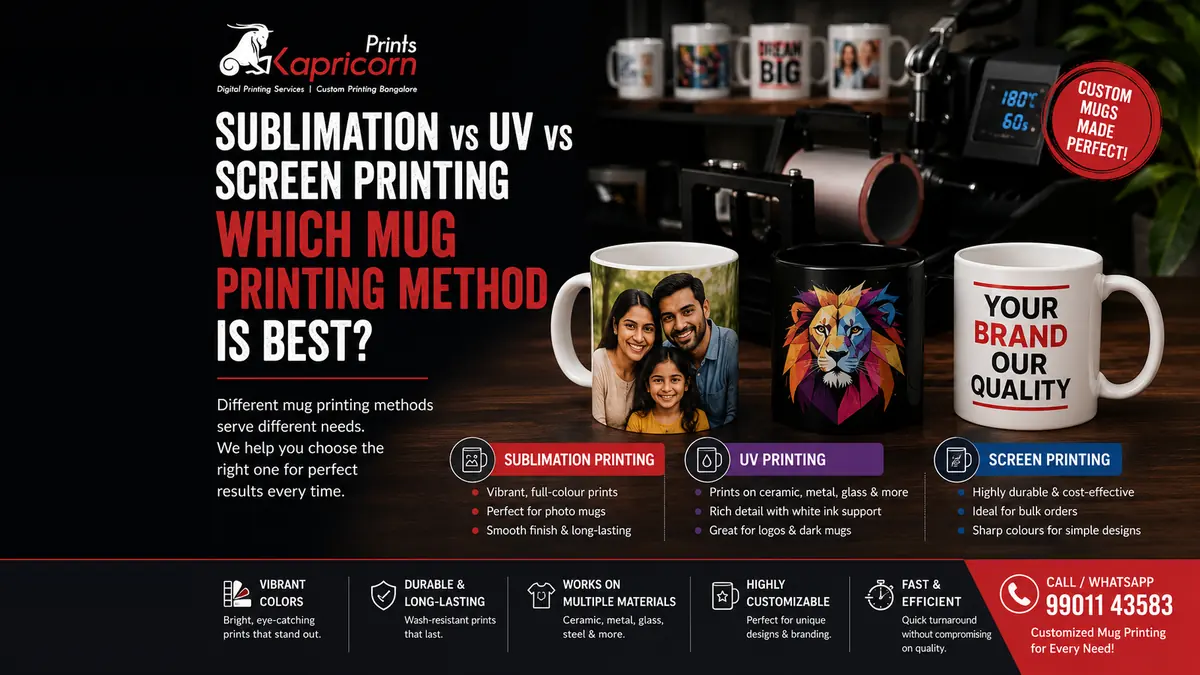
When ordering customised mugs, choosing the right printing method is just as important as choosing the mug itself. Sublimation, UV printing and screen printing can all produce excellent results, but they suit different mug materials, artwork styles, quantities, budgets and usage conditions.
A method that works well for one personalised photo mug may not be economical for 1,000 corporate logo mugs. Similarly, a process suitable for a white ceramic mug may not work the same way on stainless steel, glass or coloured mugs.
Kapricorn Prints provides customised mug printing in Bangalore for individual gifts, corporate branding, employee kits, promotional campaigns, events and bulk requirements. We recommend the printing process based on the mug material, artwork, quantity, expected usage, delivery timeline and budget instead of forcing every order into one method.
This guide explains how sublimation, UV printing and screen printing differ, where each method works best and how to choose the right option for your mug printing requirement.
Table of Contents
- Sublimation vs UV vs Screen Printing: Quick Comparison
- Our Recommendation
- What Is Sublimation Mug Printing?
- What Is UV Mug Printing?
- What Is Screen Printing on Mugs?
- Sublimation vs UV Printing: What Is the Difference?
- Sublimation vs Screen Printing: Which Is Better?
- UV Printing vs Screen Printing: Which Is Better?
- Which Printing Method Is Best for Ceramic Mugs?
- Which Printing Method Is Best for Stainless-Steel Mugs?
- Which Printing Method Is Best for Glass Mugs?
- Which Method Is Best for Corporate Logo Mugs?
- Which Method Is Best for Photo Mugs?
- Which Mug Printing Method Lasts the Longest?
- Recommended Care Instructions for Printed Mugs
- How Much Does Mug Printing Cost in Bangalore?
- Can You Print Only One Mug?
- Can Every Mug Have a Different Name?
- What Is a Magic Mug?
- Full-Wrap Printing vs Logo Printing
- One-Side vs Two-Side Mug Printing
- How to Choose the Right Mug Printing Method
- Common Mug Printing Mistakes to Avoid
- How Kapricorn Prints Helps You Select the Method
- Frequently Asked Questions
- How Kapricorn Prints Recommends This
- Related Guides
- Get a Mug Printing Quote in Bangalore
Sublimation vs UV vs Screen Printing: Quick Comparison
| Factor | Sublimation Printing | UV Printing | Screen Printing |
|---|---|---|---|
| Best suited for | Photo mugs, personalised mugs and full-colour designs | Logos, names and detailed graphics on different mug materials | Medium and large quantities with repeated designs |
| Typical quantity | One piece to medium quantities | Low to medium quantities | Medium to high quantities |
| Number of colours | Full colour | Full colour | Usually priced by number of colours |
| Best mug material | Specially coated ceramic and compatible sublimation products | Ceramic, metal, glass and selected coated surfaces | Ceramic, glass, metal and selected promotional drinkware |
| Photograph printing | Excellent | Very good | Possible, but generally less practical |
| Print area | Usually wraparound or fixed printable area | Flexible placement depending on machine and mug shape | Best for defined repeated print areas |
| Personalised names | Excellent | Excellent | Less convenient when every mug is different |
| White ink | Not normally required on white coated mugs | Available on compatible UV systems | Available through suitable ink systems |
| Metallic or dark mugs | Limited unless specially coated | Often a better option | Possible with correct ink and preparation |
| Setup requirement | Artwork preparation, transfer paper and heat pressing | Digital file setup and direct UV printing | Screen preparation for every colour |
| Economical for one mug | Yes | Yes | Usually no |
| Economical for bulk orders | Sometimes | Sometimes | Often the strongest option |
| Print feel | Smooth when properly transferred | Slightly raised or layered depending on ink coverage | Depends on ink thickness and number of layers |
| Variable artwork | Easy | Easy | Less efficient |
| Typical use | Photo gifts, birthday mugs, farewell mugs and customised office mugs | Premium logo mugs, metal mugs, bottles and mixed-material gifts | Corporate campaigns, promotional mugs and large repeated orders |
This table is a general guide. The final recommendation should consider the mug material, coating, shape, print area, artwork, quantity, washing conditions and expected daily use.
Our Recommendation
At Kapricorn Prints, we do not automatically recommend one mug printing method for every order.
We compare:
- Mug material
- Mug colour
- Surface coating
- Artwork type
- Number of colours
- Print dimensions
- Quantity
- Personalisation requirements
- Delivery timeline
- Budget
- Expected usage
- Washing and care conditions
This helps us select the most suitable method rather than using a one-size-fits-all recommendation.
For example, one personalised photo mug will usually suit sublimation. A premium logo on a stainless-steel mug may suit UV printing. A bulk order of identical company mugs may be more economical through screen printing.
What Is Sublimation Mug Printing?
Sublimation printing is one of the most commonly used methods for personalised ceramic mugs.
The design is first printed onto specialised transfer paper using sublimation ink. The printed paper is wrapped around a compatible coated mug and placed inside a mug heat press. Under controlled heat and pressure, the ink converts into gas and bonds with the mug’s coating.
The design does not simply sit on top of the surface like a sticker. It becomes part of the compatible coating, creating a smooth and durable print when the process is carried out correctly.
Main Advantages of Sublimation Mug Printing
- Excellent for photographs, gradients and multicolour artwork
- Suitable for one personalised mug or small quantities
- Produces smooth prints without a heavy raised layer
- Allows different names, photographs or messages on every mug
- Works well for wraparound designs
- Reproduces detailed artwork and small text
- Suitable for birthday, anniversary and farewell gifts
- Practical for employee names and personalised office mugs
- Fast production for print-ready orders
- No separate screens are required
Sublimation is frequently selected for photo mugs, birthday gifts, couple mugs, farewell gifts, employee gifts, event merchandise and individually named corporate mugs.
Limitations of Sublimation Mug Printing
Sublimation does not work on every ordinary mug.
The mug generally needs a compatible polymer coating designed to accept sublimation ink. Standard uncoated ceramic mugs may not produce the required result.
Sublimation also works best on white or light-coloured surfaces because the ink is transparent. It does not normally print white ink. On dark-coloured mugs, the original mug colour can interfere with the artwork unless the product includes a specially prepared printable area.
The final result also depends on:
- Coating quality
- Mug surface consistency
- Transfer paper
- Sublimation ink
- Press temperature
- Pressure
- Heating time
- Artwork colour profile
- Mug alignment
Poor-quality coated mugs may show faded colours, uneven transfers or inconsistent print density.
What Is UV Mug Printing?
UV printing is a digital printing process in which specialised ink is applied directly onto the mug or drinkware surface and cured immediately using ultraviolet light.
Unlike sublimation, UV printing does not depend on the design converting into gas and bonding with a sublimation coating. It prints directly onto a compatible surface.
UV printing can be especially useful for materials or colours that are unsuitable for standard sublimation.
Main Advantages of UV Mug Printing
- Prints directly onto compatible surfaces
- Suitable for ceramic, glass, metal and selected coated products
- Can reproduce detailed logos and full-colour artwork
- White ink may be used beneath colour artwork
- Suitable for dark or coloured surfaces
- Allows different names or designs on each product
- Practical for premium corporate gifting
- Works well for logos, text and smaller branded areas
- No separate screen is required for every colour
- Can create a slightly raised or premium print effect
- Useful for metal mugs, tumblers, sippers and selected bottles
UV printing is often selected when the mug material, shape or colour is not suitable for conventional sublimation.
Limitations of UV Mug Printing
UV printing requires correct surface preparation and adhesion testing.
Not every mug surface accepts UV ink equally well. Smoothness, coating, curvature and surface treatment can all affect print adhesion.
The printed ink generally sits on the surface rather than becoming part of a sublimation coating. As a result, durability can depend heavily on:
- Surface preparation
- Primer or adhesion promoter
- Ink quality
- Curing
- Print thickness
- Handling
- Washing conditions
- Abrasion
- Dishwasher exposure
Some mug shapes may also limit the printable area because the print head needs sufficient clearance and a stable printing surface.
For unusual products, a test print may be recommended before confirming bulk production.
What Is Screen Printing on Mugs?
Screen printing uses a prepared mesh screen to transfer ink onto the mug surface.
A stencil is created for the design, and ink is pushed through the open parts of the screen. Each colour normally requires a separate screen and production step.
Screen printing requires more initial setup than sublimation or UV printing. However, once the screens are prepared, the same design can be reproduced efficiently across a large quantity.
When Screen Printing Is Ideal
Screen printing is particularly suitable for:
- Medium and large quantities
- Repeated company logos
- One-colour or limited-colour designs
- Promotional campaigns
- Corporate events
- Product launches
- Dealer or distributor gifts
- Employee joining kits
- Conference merchandise
- Retail promotional mugs
- Orders likely to repeat in future
The setup cost becomes easier to justify as quantity increases because it is distributed across more mugs.
Main Advantages of Screen Printing
- Economical for larger quantities
- Consistent reproduction of repeated artwork
- Strong spot colours
- Suitable for simple company logos
- Good for long production runs
- Efficient when every mug carries the same design
- Suitable for repeat corporate orders
- Can work on different materials with the correct ink system
Limitations of Screen Printing
Screen printing is usually not economical for one mug or a very small order because screen preparation is required regardless of quantity.
It also becomes more complex when:
- Artwork contains many colours
- Every mug requires a different name
- The design includes photographs
- The artwork contains detailed gradients
- Multiple versions are required
- Print quantity is low
- The print area wraps around an irregular shape
For highly detailed or personalised artwork, sublimation or UV printing is generally more practical.
Sublimation vs UV Printing: What Is the Difference?
The main difference is how the print bonds with the mug.
In sublimation, the ink becomes part of a compatible coated surface through heat. In UV printing, the ink is printed directly onto the surface and cured using ultraviolet light.
Sublimation Is Usually Better For
- White coated ceramic mugs
- Photo mugs
- Full-wrap artwork
- Photographs
- Gradients
- Personalised gifts
- One-off mugs
- Multiple designs within the same order
- Smooth, integrated prints
UV Printing Is Usually Better For
- Coloured mugs
- Dark mugs
- Metal mugs
- Stainless-steel drinkware
- Glass products
- Premium logo placement
- White-ink requirements
- Smaller print areas
- Mixed product materials
For a white ceramic photo mug, sublimation is often the natural choice. For a black metal mug with a white and coloured company logo, UV printing may be the better option.
Sublimation vs Screen Printing: Which Is Better?
Sublimation is easier to justify for lower quantities, personalised artwork, photographs and designs with many colours.
Screen printing becomes more attractive when the quantity rises and the same logo is repeated on every mug.
For example:
- Ten farewell mugs with different employee photographs will usually suit sublimation.
- Fifty mugs with different names and the same company logo may also suit sublimation.
- Five hundred mugs with one repeated two-colour company logo may be more economical through screen printing.
The correct decision depends on artwork, quantity, mug coating, colour count and delivery schedule.
UV Printing vs Screen Printing: Which Is Better?
UV printing is usually more practical for lower quantities, detailed artwork, multiple colours and variable names.
Screen printing becomes more economical for larger quantities of the same repeated design, especially when the artwork uses one or two solid colours.
UV printing may be selected for:
- Twenty premium metal mugs
- Fifty different employee names
- Multicolour artwork
- White ink on a dark mug
- Detailed logos on mixed materials
Screen printing may be selected for:
- Five hundred promotional mugs
- One repeated company logo
- One or two colours
- Large campaign quantities
- Recurring bulk orders
When an order sits between the two, Kapricorn Prints can compare both methods before production is confirmed.
Which Printing Method Is Best for Ceramic Mugs?
All three methods may be suitable for ceramic mugs, depending on the mug coating and artwork.
Sublimation
Best for white, sublimation-coated ceramic mugs, photo prints, colourful artwork and personalisation.
UV Printing
Useful for coloured ceramic mugs, smaller logo areas, white ink, detailed branding and surfaces that are unsuitable for standard sublimation.
Screen Printing
Suitable for larger quantities of identical ceramic mugs, especially for simple logos with limited colours.
The mug itself should be checked before selecting the method. Two ceramic mugs may look similar but have different coatings, surface finishes and heat tolerance.
Which Printing Method Is Best for Stainless-Steel Mugs?
For stainless-steel mugs, tumblers and sippers, UV printing and screen printing are usually the main candidates.
UV printing works well for:
- Short runs
- Premium branding
- Multiple colours
- Individual names
- Detailed logos
- Variable artwork
Screen printing works well for:
- Large repeated quantities
- Simple logos
- Limited colours
- Promotional campaigns
- Corporate distribution
Some specially coated metal drinkware may support sublimation, but this should not be assumed without checking the product specification.
Which Printing Method Is Best for Glass Mugs?
Glass mug printing depends on the glass type, surface treatment, heat resistance and intended usage.
UV printing can be suitable for detailed artwork and lower quantities. Screen printing may be suitable for larger repeated orders.
Certain specially coated glass mugs may support sublimation, but normal glass should not automatically be treated as sublimation-compatible.
A test sample is recommended for unusual glass products or large production runs.
Which Method Is Best for Corporate Logo Mugs?
For corporate mug printing, the decision usually comes down to quantity, artwork, material and personalisation.
A small order of employee mugs with individual names may suit sublimation or UV printing.
A premium set of stainless-steel mugs with detailed logos may suit UV printing.
Hundreds or thousands of ceramic mugs with the same one-colour logo may favour screen printing.
Corporate buyers should confirm:
- Total quantity
- Mug type
- Mug colour
- Logo colours
- Print dimensions
- Print position
- Individual names
- Packaging
- Delivery locations
- GST invoice requirement
- Approval process
- Deadline
- Repeat-order possibility
These details help avoid delays and pricing changes after production planning begins.
Which Method Is Best for Photo Mugs?
Sublimation is generally the preferred method for photo mugs.
It reproduces photographs, gradients, skin tones, backgrounds and multicolour artwork effectively on compatible white-coated mugs.
For the best result:
- Use the original high-resolution photograph
- Avoid screenshots
- Avoid WhatsApp-compressed images where possible
- Confirm the printable area
- Check the mug handle position
- Review the artwork preview
- Keep important faces away from extreme edges
- Avoid placing important text directly near the handle
A low-resolution photo may look acceptable on a phone screen but become visibly blurred when enlarged for printing.
Which Mug Printing Method Lasts the Longest?
Durability depends on more than the printing method.
A print can fail early if:
- The mug coating is poor
- The surface is not prepared properly
- The print is under-cured
- The mug is washed aggressively
- Abrasive scrubbers are used
- Strong chemicals are applied
- The mug is repeatedly exposed to high dishwasher temperatures
- The printed area is scraped against hard objects
A properly produced sublimation print on a high-quality coated mug can remain durable because the image is bonded into the coating.
UV and screen prints can also perform well when the surface, ink, curing and production settings are suitable.
However, customers should not assume every printed mug is automatically dishwasher-safe or microwave-safe. Suitability depends on the mug material, coating and printing process.
Recommended Care Instructions for Printed Mugs
To improve print life:
- Wash gently with a soft sponge
- Avoid steel scrubbers and abrasive pads
- Avoid harsh bleach or strong cleaning chemicals
- Do not scratch the printed area
- Avoid prolonged soaking
- Follow the mug manufacturer’s care instructions
- Confirm dishwasher suitability before machine washing
- Confirm microwave suitability before heating
- Handle premium or metallic mugs carefully
- Do not compare all printed mugs as if they use the same coating
Kapricorn Prints can provide job-specific care guidance when required.
How Much Does Mug Printing Cost in Bangalore?
Mug printing prices depend on:
- Mug type
- Mug material
- Mug colour
- Printing method
- Quantity
- Artwork complexity
- Number of colours
- Print dimensions
- Number of print positions
- Personalisation
- Packaging
- Turnaround time
- Delivery location
- GST
A single personalised photo mug will be priced differently from 500 corporate mugs with one repeated logo.
Similarly, a basic white ceramic mug is priced differently from:
- Magic mug
- Colour-handle mug
- Inner-colour mug
- Stainless-steel mug
- Travel mug
- Glass mug
- Frosted mug
- Premium gift mug
- Tumbler
- Sipper
- Insulated drinkware
For an accurate quotation, share:
- Quantity
- Mug type
- Mug colour
- Logo or artwork
- Print size
- Print position
- Required delivery date
- Packaging requirement
- Whether every mug needs a different name
- Delivery location
Kapricorn Prints provides GST invoices, and the quotation can separate product, printing, packaging, delivery and tax where applicable.
For a broader overview of mug types, pricing, turnaround options and how to place an order, see our complete guide to custom mug printing in Bangalore.
Can You Print Only One Mug?
Yes.
Single-mug printing is possible through sublimation or UV printing, depending on the mug material and artwork.
Screen printing is generally not commercially practical for one mug because the screen setup is required regardless of quantity.
One-piece orders are popular for:
- Birthday gifts
- Anniversary gifts
- Farewell gifts
- Couple mugs
- Photo mugs
- Teacher gifts
- Employee appreciation
- Personalised office mugs
- Return gift samples
- Event samples
Can Every Mug Have a Different Name?
Yes.
Sublimation and UV printing are well suited for variable personalisation.
Every mug can carry a different:
- Name
- Photograph
- Employee ID
- Design
- Number
- Department
- Message
- QR code
This is useful for employee welcome kits, school gifts, event merchandise, team gifts and personalised corporate orders.
Screen printing is less convenient when every mug requires different artwork.
What Is a Magic Mug?
A magic mug is a heat-sensitive mug that appears dark when cold and reveals the printed image when a hot beverage is poured inside.
The outer coating reacts to heat, allowing the hidden artwork to become visible.
Magic mugs are popular for:
- Birthday gifts
- Couple gifts
- Promotional campaigns
- Surprise gifts
- Personal messages
- Event merchandise
The visibility, colour change and print quality depend on the mug coating and production quality.
Magic mugs should be handled carefully because their specialised outer coating may be more sensitive to scratching and aggressive washing.
Full-Wrap Printing vs Logo Printing
A full-wrap design covers a wider area around the mug and may include photographs, backgrounds, text and decorative elements.
A logo print usually occupies a smaller defined area on one or both sides.
Full-Wrap Printing Is Suitable For
- Photo collages
- Promotional artwork
- Event graphics
- Personal messages
- Illustrated designs
- Product branding
Logo Printing Is Suitable For
- Company mugs
- Employee kits
- Office pantry mugs
- Dealer gifts
- Client gifts
- Conferences
- Promotional campaigns
The correct print area depends on the mug’s shape, handle position and printing method.
One-Side vs Two-Side Mug Printing
One-side printing places the design on a single visible area.
Two-side printing can place:
- The same logo on both sides
- A logo on one side and a name on the other
- A photograph on one side and a message on the other
- Different artwork for right-handed and left-handed visibility
The final layout should be approved before production.
It is important to specify whether the design should face the user or face outward while the mug is being held.
How to Choose the Right Mug Printing Method
Choose sublimation for:
- Photo mugs
- Full-colour artwork
- One piece or small quantities
- White coated ceramic mugs
- Personalised names
- Wraparound designs
- Gradients and detailed graphics
Choose UV printing for:
- Coloured mugs
- Dark mugs
- Metal mugs
- Glass products
- Detailed logos
- Premium gifts
- White ink
- Variable names
- Lower quantities
Choose screen printing for:
- Medium and large quantities
- Repeated designs
- Limited colours
- Promotional campaigns
- Company logos
- Bulk distribution
- Repeat corporate orders
When two methods appear suitable, ask for a physical sample or production test before approving a large order.
Common Mug Printing Mistakes to Avoid
Selecting Only by Price
The cheapest method may not suit the mug material, artwork or quantity.
Sending a Low-Resolution Logo
Screenshots and compressed files can appear blurred when printed. Vector files or high-resolution artwork are preferable.
Not Confirming the Mug Material
Ceramic, glass, steel and coated products require different production methods.
Assuming Every Mug Is Suitable for Sublimation
Sublimation usually requires a compatible coated surface.
Skipping Print Dimensions
“Print the logo on the mug” is not a complete specification. Width, height and position should be approved.
Ignoring the Handle Position
Artwork may appear incorrectly aligned if the handle orientation is not considered.
Not Specifying Left-Handed or Right-Handed Viewing
This matters when only one side is printed.
Using Very Small Text
Fine text may become difficult to read, especially on curved surfaces.
Skipping a Sample for Bulk Orders
A physical sample helps confirm mug quality, artwork size, colour, placement and printing method.
Assuming Exact Screen-to-Print Colour Matching
Phone screens and monitors display colour differently from printed products. Brand colours should be supplied with appropriate references wherever possible.
Confirming the Order Without Packaging Details
Individual boxes, gift boxes, partitions, bubble wrapping and transport packing can affect cost and delivery safety.
Ignoring Delivery Risk
Mugs are fragile. Bulk packing and transporter handling should be planned carefully.
How Kapricorn Prints Helps You Select the Method
Kapricorn Prints reviews:
- Mug type
- Surface material
- Coating
- Artwork
- Logo colours
- Print dimensions
- Quantity
- Personalisation
- Packaging
- Deadline
- Delivery requirement
- Reorder possibility
We then recommend sublimation, UV printing or screen printing based on the complete job rather than selecting a method only because a machine is available.
For bulk corporate orders, we can also help plan:
- Employee name lists
- Department-wise packing
- Individual boxes
- Logo placement
- Artwork approval
- Sample approval
- Quantity breakup
- Dispatch schedule
- GST documentation
- Repeat-order consistency
Frequently Asked Questions
Is Sublimation Better Than UV Printing?
Not universally.
Sublimation is excellent for photo-quality printing on compatible coated mugs. UV printing offers greater flexibility across coloured, dark, metal and selected glass surfaces.
Is Sublimation Better Than Screen Printing?
Sublimation is more practical for low quantities, personalised artwork and photographs. Screen printing is often more economical for larger quantities of the same repeated design.
Is UV Printing Better Than Screen Printing?
UV printing is usually better for lower quantities, detailed artwork, multiple colours and individual names. Screen printing is often better for larger repeated orders with limited colours.
Can You Print One Mug?
Yes. Single mugs can usually be printed through sublimation or UV printing, depending on the mug material.
Which Method Is Best for Photo Mugs?
Sublimation is generally the preferred method for photographs on compatible white coated ceramic mugs.
Which Method Is Best for Corporate Logo Mugs?
Small personalised orders may suit sublimation or UV printing. Larger repeated logo orders may suit screen printing.
Can You Print on Black Mugs?
Yes, depending on the mug type and printing method. UV printing or specially prepared printable areas may be used. Standard sublimation ink does not normally provide white ink.
Can You Print on Stainless-Steel Mugs?
Yes. UV printing and screen printing are common options. Specially coated sublimation-compatible metal mugs may also be available.
Can You Print on Glass Mugs?
Yes, subject to checking the glass type, coating and printing method.
Can Every Mug Have a Different Name?
Yes. Sublimation and UV printing are especially suitable for variable names and artwork.
Is Mug Printing Dishwasher-Safe?
It depends on the mug, coating, ink and printing method. Dishwasher safety should be confirmed for the specific product.
Is Mug Printing Microwave-Safe?
It depends on the mug material and coating. Metallic mugs and certain special mugs should not be placed in a microwave.
Does Mug Printing Fade?
A properly produced print can last well, but harsh washing, abrasive scrubbers, poor coatings and aggressive handling can reduce print life.
Can You Print a Full-Wrap Design?
Yes, on suitable mugs and within the available printable area.
Can You Print on Both Sides?
Yes. The same or different artwork can be printed on each side, depending on the production method.
What File Format Should I Send?
Vector formats such as AI, EPS, PDF or SVG are preferred for logos. High-resolution PNG, JPEG, TIFF or PDF files may be used for photographs.
Can You Design the Artwork?
Yes. Artwork preparation or design support can be quoted when required.
Do You Provide a Sample Before Bulk Production?
A paid or approved sample can be arranged for suitable bulk orders, depending on the product and timeline.
Do You Provide Individual Mug Boxes?
Yes. Standard boxes, individual packaging and premium gift packaging can be quoted depending on availability.
Do You Deliver Mug Orders in Bangalore?
Yes. Delivery can be arranged based on quantity, location, packaging and timeline.
How Kapricorn Prints Recommends This
Best choice for sublimation: Photo mugs, colourful designs, white coated ceramic mugs, personalised names and small-to-medium quantities.
Best choice for UV printing: Dark mugs, coloured mugs, metal drinkware, detailed logos, white ink, premium gifts and variable artwork.
Best choice for screen printing: Repeated corporate logos, limited colours, medium-to-large quantities and recurring promotional orders.
Typical turnaround: Standard turnaround depends on mug stock, artwork approval, quantity, printing method, packaging and production capacity. Urgent service may be available for qualifying print-ready orders.
Minimum order: No minimum may apply for selected sublimation and UV mug products. Screen printing is generally quoted for medium and bulk quantities where setup becomes commercially practical.
Common mistake to avoid: Confirming bulk production without approving the mug type, print dimensions, handle orientation, artwork placement and physical sample.
Need help choosing? Share your artwork, quantity, mug type, delivery date and packaging requirement. Kapricorn Prints will recommend the most suitable printing method and provide a quotation.
Related Guides
- T-Shirt Printing in Bangalore
- DTF vs DTG vs Screen Printing
- Corporate Gift Printing in Bangalore
- Screen Printing in Bangalore
- Promotional Product Printing
Get a Mug Printing Quote in Bangalore
Kapricorn Prints provides customised mug printing in Bangalore for:
- Photo gifts
- Birthday mugs
- Anniversary gifts
- Farewell gifts
- Employee joining kits
- Corporate gifts
- Office branding
- Conferences
- Exhibitions
- Product launches
- Dealer meets
- Promotional campaigns
- Events
- Schools and colleges
- Personalised merchandise
We offer printing on selected ceramic mugs, photo mugs, magic mugs, colour-handle mugs, inner-colour mugs, metal mugs, glass mugs, travel mugs, tumblers, sippers and promotional drinkware.
To receive an accurate quotation, send us:
- Required quantity
- Mug type
- Mug colour
- Logo or artwork
- Print dimensions
- Print placement
- Individual names, if any
- Packaging requirement
- Delivery location
- Required date
WhatsApp us on 99011 43583 Call 99011 43583 · Contact Kapricorn Prints Request a Mug Printing Quote
Kapricorn Prints — digital and commercial printing in Jayanagar, Bangalore since 2015.